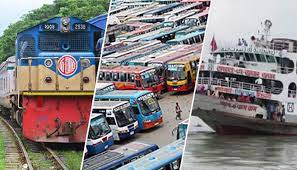
News Desk: A decade ago, initiatives were taken to increase regional connectivity between Bangladesh, India, Nepal and Bhutan. Due to its geographical location, Bangladesh has been at the center of transit-transshipment discussions. For over a decade, various initiatives have been taken to enhance regional connectivity between Bangladesh, India, Nepal and Bhutan. In addition to increasing people-to-people communication, new routes have been introduced for easy transportation of goods by sea, road, rail and air. Due to its geographical location, Bangladesh is at the center of building this four-nation regional communication system. Bilateral or multilateral Bangladesh is being given priority in almost all ways.
Bangladesh has already provided transit-transit facilities by sea and road to the northeastern states of India. The port of Chittagong has also been opened for India to bring and take goods. Originally, after the present government came to power in the first term, discussions started with India to increase trade and commerce.
India has been interested in transiting this route regularly since 2011 after taking heavy equipment from Tripura’s Palatana power plant with special facilities through Ashuganj seaport. This route was officially launched in 2016 with a fee. Later, new trade routes were introduced between the two countries by sea, road and sea. Besides, Bangladesh, Bhutan, India and Nepal (BBIN) have also signed an agreement on free movement.
In order to increase people-to-people communication, several routes have also been introduced between Bangladesh and India for direct passenger transport. Such as Khulna-Kolkata railway; Dhaka-Agartala by bus; Dhaka-Guwahati flight. Passenger train between Dhaka and Siliguri is scheduled to start this month. Talks on launching direct freight and passenger transport links from Bangladesh to Bhutan and Nepal are also in the final stages. The Dhaka-Siliguri-Gangtok and Dhaka-Kathmandu buses have also been piloted.
Mostafizur Rahman, a special fellow at the Center for Policy Dialogue (CPD), a private research institute, said that over the past decade, some agreements and infrastructures related to the interaction between India and neighboring countries have been built. These are positive steps. The implementation of the measures needs to be accelerated. He said that investment needs to be increased in parallel with transport connectivity and trade needs to be facilitated by removing tariff-non-tariff barriers. Then the full success of regional communication including transit-transshipment will be achieved. He further said that trade and commerce would be further expanded if freight trucks could easily cross the border between Bangladesh, India, Nepal and Bhutan.
The World Bank has conducted a study on how much a country would benefit from increased international connectivity between Bangladesh and India. According to the World Bank report released on March 9, Bangladesh’s national income will increase by 18 percent if uninterrupted transport between Bangladesh and India can be introduced. And India’s national income will increase by 8 percent. Real income will increase by 67 percent in Dhaka district and 59 percent in Chittagong district. Overall, the actual income of the eastern districts of Bangladesh and some western districts will increase by 25 to 40 percent. Bangladesh’s exports to India could increase by about 300 percent if the two countries’ Free Trade Agreement (FTA) as well as ensuring uninterrupted traffic flow.
Friendship bridge is showing hope
A Bangladesh-India Friendship Bridge over the Feni River was inaugurated on March 8 at Ramgarh in Khagrachhari, Bangladesh and Sabroom area in South Tripura, India. The bridge is now referred to as the ‘gateway’ to the east of South Asia. Because, using the port of Chittagong, goods will be easily brought to and from Assam, Tripura and seven states in the north-east of India.
From the British period, along the Moulvibazar of Bangladesh, there was a railway across the border to Dharmanagar in Karimganj, Assam. By 2015, the railway line has been extended from Dharmanagar in Karimganj, Assam to Agartala in Tripura. Now the construction of the railway from Agartala further south to Sabroom is also nearing completion. With the launch of this railway, it will be possible to transport passengers and goods from Tripura’s subroom to Guwahati in Assam via Agartala. From there a railway came to Calcutta via New Jalpaiguri. Another railway line runs from Guwahati to Dibrugarh, a border town near Arunachal Pradesh.
This railway is now being considered as the economic corridor or lifeline of seven northeastern states including Assam, Tripura, Arunachal, Mizoram. Besides, there are roads. Direct road connection with the subroom has been introduced through Ramgarh Maitri Bridge in Khagrachhari. From Chittagong port to Sitakunda, Mirsarai only 100 km of the road from Chittagong port to Tripura subroom will be shipped.
New waterways are opening up
At least four new waterways have been launched between Bangladesh and India in the last 10 years. One of these is a transit and three are bilateral trade routes. From Kolkata to Ashuganj by water and from Ashuganj by road to Akhaura to Agartala — this route is basically a transit route. Shipments of stone and iron for the construction of railways in Tripura have gone this way.
Last November, transit goods were brought and taken in another way. That is, from Karimganj in Assam to Ashuganj via Zakiganj in Sylhet by boat and later by road to Agartala. About 21,000 tons of goods have so far gone to India through Ashuganj seaport. A jetty and warehouse have already been constructed at Ashuganj seaport. Work is underway to upgrade the 47 km road from Ashuganj to Akhaura into four lanes with Indian loan.
By water from Daudkandi to Comilla via Gumti river to Sonamura in Sipaizla district of Tripura; Later on the road from there to Agartala — this road was officially launched last August. This has been done to expand bilateral trade. There is a navigability crisis in this way. The Bangladesh Shipping Authority (BIWTA) is now studying where the navigability crisis is. BIWTA will soon start excavations to overcome the navigability crisis. Besides, trade has started between Kurigram and Dhubri in Assam through the Brahmaputra river.
Large stones are brought in this way. Last September, BIWTA approved the movement of goods from Sultanganj in Godagari upazila of Rajshahi to Maya seaport in Murshidabad. Now awaiting clearance from the customs department.
BIWTA Director Rafiqul Islam said the cost of transporting goods by water is much lower. So in the last few years multiple waterways have been launched with India. If these waterways are fully operational, Bangladesh’s exports to North-East India will increase. Indian traders will be able to take goods from Bangladesh by sea at the fastest time at low cost. He said excavation is already underway on the Zakiganj waterway. Various initiatives have been taken to make Gumti and other rivers suitable for excavation and night movement.
Transportation of goods by water has increased
Import and export trade also took place between the two countries under the 1972 Naval Protocol. Transportation of more than one lakh tonnes of goods between the two countries has increased in four years. In the 2016-17 financial year, the total import and export by sea was about 26 lakh 6 thousand tons. In the 2018-19 financial year, it increased to 27 lakh 2 thousand tons. In the last financial year, the amount was 23 lakh 7 thousand tons. However, due to the corona, the waterways were closed for about three months.
Passenger transport from Kolkata in West Bengal to Guwahati in Assam via Khulna-Chandpur-Nagarbari-Sirajganj-Kurigram in Bangladesh has started from 2019. Two Indian ships and one Bangladeshi ship are transporting passengers. However, the issue of passenger transport has not been reported regularly.
Chittagong port started to be used
In November 2018, an agreement was reached between the two countries to transport goods to the northeastern states of India using the port of Chittagong in Delhi. In October of the following year, the Standard of Procedure (SOP) was signed on the method of transporting goods on this route. In July 2020, India took a test shipment using the port of Chittagong for the first time. A consignment of four containers of steel and consumer goods came by ship from Calcutta to Chittagong port and later from Chittagong to Agartala via Comilla and Akhaura. The issue of bringing and taking goods using Chittagong is now waiting to be regularized.
Indian goods will be unloaded through Chittagong port and will go to Tripura by rail and road. The shipment of goods will go from Chittagong port to Agartala via Comilla via Kasbar Gangasagar area. Construction of 11 km railway line from Gangasagar area to Agartala is in full swing. Besides the Ramgarh-Sabroom Maitri Bridge, Indian traders will be able to take goods by road through Bibirbazar in Comilla and Akhaura in Brahmanbaria.
According to one source, Dhaka-Kolkata-Kathmandu-Thimphu
In order to increase people-to-people communication as well as to facilitate the transportation of goods, an initiative was taken six-seven years ago to simultaneously increase regional connectivity between Bangladesh, India, Nepal and Bhutan, known as BBIN. Under the BBIN, a free motor vehicle trade agreement was signed between the four countries in June 2015 in Thimphu, the capital of Bhutan. But the upper house of Bhutan’s parliament has not yet ratified the agreement, citing environmental concerns. For the time being, steps have been taken to implement the free movement agreement excluding Bhutan.
In November 2015, a consignment of Vodafone parts went from Kolkata to Agartala via Akhaura in a test shipment by road through Bangladesh. Recently, Nepal and Bhutan have been given the opportunity to come to Bangladesh using their own territory. Nepal and Bhutan have long sought access to the Mongla port. That too will be easy now. Besides, Bangladesh has already given Bhutan the opportunity to use Syedpur port.
Commerce Secretary. In this regard, Zafar Uddin said, trade and commerce will increase if the interaction with the neighboring countries increases. For this we have to create infrastructure as well as increase investment. He said exports to India have crossed 1 billion in the last 10 years. Besides overcoming the navigability crisis in the waterways, the port facilities are also being increased. Gradually the opportunities for trade assistance are increasing.