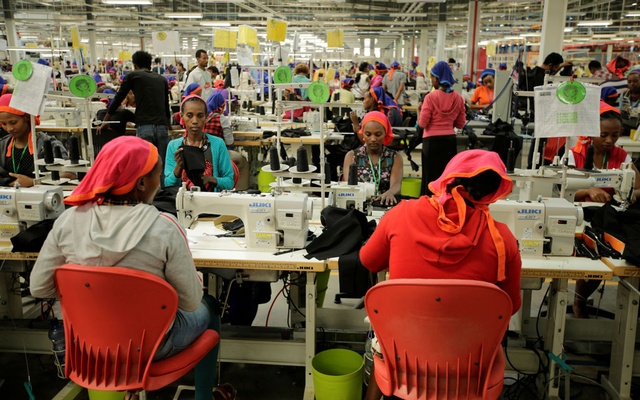
When Bangladeshi textile firm DBL set up shop in Ethiopia two years ago, the African nation was the garment industry’s bright new frontier, boasting abundant cheap labour and a government keen to woo companies with tax breaks and cheap loans.
Last month, as fighting raged in the northern Tigray region, DBL’s compound was rocked by an explosion that blasted out the factory’s windows, radically altering its business calculus.
“All we could do was to pray out loud,” said Adbul Waseq, an official at the company, which makes clothes mainly for Swedish fashion giant H&M and is one of at least three foreign garment makers to have suspended operations in Tigray.
“We could have died,” Waseq told Reuters.
For over a decade, Ethiopia has invested billions of dollars in infrastructure such as hydro-electric dams, railways, roads as well as industrial parks in an ambitious bid to transform the poor, mainly agrarian nation into a manufacturing powerhouse.
By 2017, it was the world’s fastest growing economy.
A year later, Prime Minister Abiy Ahmed took office, pledging to loosen the state’s grip on an economy with over 100 million people and liberalise sectors such as telecoms, fuelling something akin to glasnost-era headiness among investors.
But for two years Ethiopia has been pummelled by challenges: ethnic clashes, floods, locust swarms and coronavirus lockdowns.
Now, fighting which erupted on Nov. 4 between the army and forces loyal to Tigray’s former ruling party, and fears it could signal a period of prolonged unrest, have served investors with a harsh reality check.
Any hesitation by investors could spell trouble as the country’s manufacturing export push isn’t yet generating enough foreign currency either to pay for all the country’s imports or keep pace with rising debt service costs. Even before the pandemic, the International Monetary Fund (IMF) had warned that Ethiopia was at high risk of debt distress.
Abiy’s government said that, amid the crises it’s facing, Ethiopia was pushing ahead with reforms that will build the foundations for a modern economy.
“Despite the unprecedented shock from COVID and continued insecurity in different parts of the country, the Ethiopian economy showed remarkable resilience,” Mamo Mihretu, senior policy adviser in the prime minister’s office, told Reuters.
PRODUCTION SUSPENDED
Ethiopia is a relatively small textiles producer with exports in 2016 of just $94 million compared with $29 billion for Vietnam and $253 billion for China in the same year, World Bank trade data showed. Its top exports are agricultural, such as coffee, tea, spices, oil seeds, plants and flowers.
But Ethiopia’s push into the textile industry over the past 10 years has been emblematic of its manufacturing ambitions.
As fighting neared Tigray’s regional capital, Mekelle, textile companies began shutting down and pulling out staff.
“It seemed that the conflict was getting closer to the city, and our worry was that we wouldn’t be able to leave,” Cristiano Frati, an electrician evacuated from a factory run by Italian hosiery chain Calzedonia, told an Italian newspaper.