There is “much more that we need to do” to tackle racism, Boris Johnson has said as he announced a new commission to look at all “aspects of inequality”.
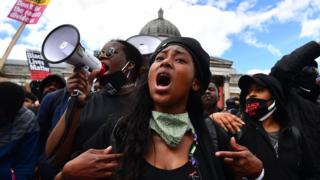
Writing in the Telegraph, the PM said “no-one who cares about this country” could ignore the anti-racist protests sparked by the killing of George Floyd.
But he added that the UK should not attempt to “re-write the past” by removing historical symbols.
The UK’s heritage should be left “broadly in peace”, he said.
Mr Johnson also condemned the “far-right thugs” involved in violent protests on Saturday, which saw more than 100 people arrested in London after thousands gathered saying they were protecting statues.
The stories behind the statues targeted in protests
Protesters clash with police in central London
He said their mission was “utterly absurd” but he added that it was “deplorable” that Sir Winston Churchill’s statue had been in danger of attack.
It comes after the statue in Parliament Square was spray-painted with the words “was a racist” last weekend. In Bristol, anti-racism protesters pulled down a statue of slave trader Edward Colston.
The prime minister said he was setting up a commission to look at inequality as it was “no use just saying that we have made huge progress in tackling racism”.
He wrote: “There is much more that we need to do; and we will. It is time for a cross-governmental commission to look at all aspects of inequality – in employment, in health outcomes, in academic and all other walks of life.”
Questions over inequality in health outcomes have been repeatedly raised during the coronavirus pandemic after figures showed more people from ethnic minority backgrounds were “disproportionately” dying with the virus.
BBC assistant political editor Norman Smith said the commission would be tasked with reporting by Christmas.
However, it is unclear whether legislation will follow as a result. Campaigners may be concerned that a number of inquiries on racial inequality have already been carried out in the past, such as the Lammy review on the treatment of black, Asian and minority ethnic individuals in the criminal justice system and Theresa May’s Race Disparity Audit, our correspondent added.
Lord Simon Woolley, founder of Operation Black Vote and the advisory chair of the government’s Race Disparity Unit, said he was “encouraged” by the announcement of the commission.
However, he said it must lead to action and structural change, for example more black teachers and a curriculum that’s “fit for purpose”.
“I’m hoping that this commission will focus on some of the solutions, some of the inequalities that have been laid bare by this deadly virus, in employment, in health, in education,” he told BBC Radio 4’s Today programme.
Media captionRacism in the UK: ‘I feel like an alien’
Thousands of people have marched in the UK as part of Black Lives Matter demonstrations following the death of George Floyd in Minneapolis last month.
Mr Johnson said the “serious points” being raised by the anti-racism demonstrators should be taken seriously.
However, he said that did not mean “wasting time” disputing the life and opinions of “every historical personality currently immortalised in bronze or stone”.
“Let’s fight racism, but leave our heritage broadly in peace. If we really want to change it, there are democratic means available in this country – thanks, by the way, to Winston Churchill,” he said.
It comes as English Heritage is reviewing London’s 950 blue plaques to check if any have “problematic” connections and will warrant extra context published about them online, as first reported in the Times.
As for statues, English Heritage also said it believes the best course of action is to give extra context. “With the statues in our care, we need to ensure that the stories of those people already commemorated are told in full, without embellishment or excuses,” it said.