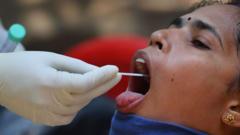
Thyrocare, a private diagnostic laboratory in India, had just started testing for Covid-19, when the Supreme Court ordered all tests to be carried out free.
“We thought the order would say the rich would pay, and the government would pay for the poor,” says Arokiaswamy Velumani, Thyrocare’s founder.
At 4,500 rupees ($59; £47), it’s not a cheap test. But the court did not clarify if and how private labs would be reimbursed. Panic stricken, some, including Thyrocare, put testing on hold.
An anxious federal government petitioned the court to reconsider – which it did.
According to the new order, issued on 13 April, the government will reimburse private labs for testing the 500 million people covered by a flagship public health insurance scheme. The rest would have to pay.
But the volte-face sparked a bigger question: can India scale up testing for Covid-19 if it’s not free?
A steep price tag
India’s numbers – 15,712 active cases and 507 deaths – are relatively low for a country of 1.3bn. Many believe this is because it’s still testing too little – as of Sunday there had been 386,791.
But scaling up is a challenge. The Indian Council of Medical Research (ICMR) has approved only one homegrown testing kit so far, imports are delayed because of a global surge in demand, and the protective gear and medical staff required to conduct tests are in short supply. Also the sheer size of India’s population, and the resources needed to reach every corner of the country, is daunting.
All of this has made testing expensive. It’s free at government hospitals and labs – and for months they were the only ones permitted to even test for coronavirus. But soon private players were roped in to support India’s underfunded and struggling public health system.